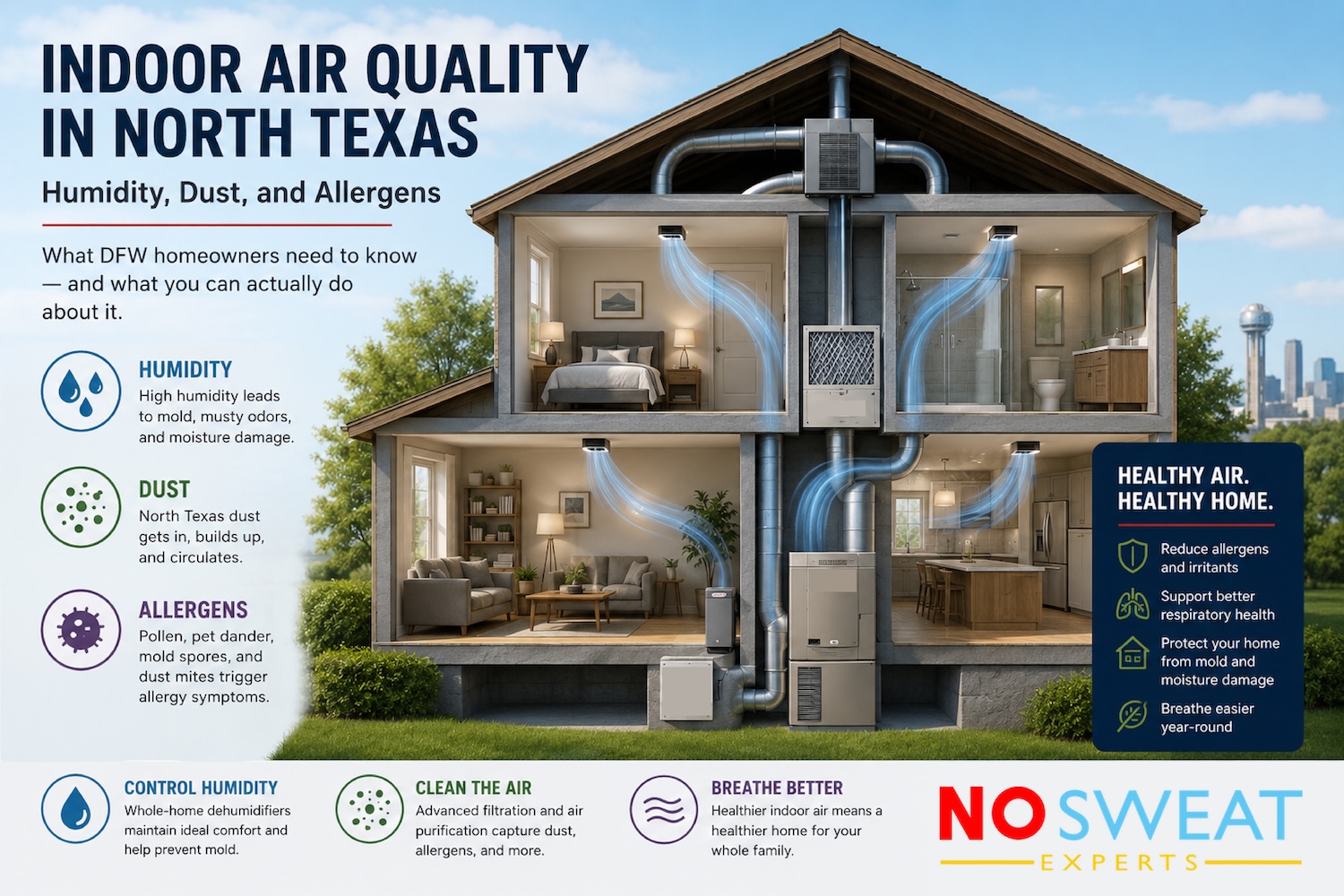
Indoor Air Quality in North Texas: Humidity, Dust, and Allergens
What DFW homeowners need to know — and what you can actually do about it
If you live in the DFW Metroplex, you already know North Texas weather is not gentle. Scorching summers, volatile spring weather, and humidity that climbs faster than your electric bill — it’s a lot for a home to manage. What most homeowners don’t realize is that the air inside their home is often in worse shape than the air outside.
We’re not talking about a minor comfort issue. Poor indoor air quality (IAQ) is directly linked to allergy symptoms, respiratory problems, mold growth, and long-term structural damage to your home. And the frustrating part? Most homeowners have no idea it’s happening until the problems are already serious.
This post covers the three biggest IAQ problems we see in North Texas homes right now — humidity, dust, and allergens — what causes them, what they do to your home and your health, and what solutions actually work.
The Humidity Problem: Why North Texas Homes Are More at Risk Than You Think
What we actually see inside DFW homes
When our technicians walk into a typical North Texas home in late spring or summer, they routinely measure indoor relative humidity (RH) readings of 65 to 70 percent. That number is significant — and most homeowners are completely unaware of it.
Here’s why it matters: mold can begin growing in a home when indoor humidity reaches 60% RH. You may see it on furniture, such as across the top of a couch, or on walls as a darker area on the paint. At 65–70%, which is what we commonly measure, the conditions are not borderline — they are actively favorable for mold development. And mold rarely announces itself. By the time you see it or smell it, it’s been growing for a while.
Why your AC alone isn’t solving this
Your air conditioning system does remove some humidity as a byproduct of cooling — but it is not designed to be a dehumidifier. In North Texas, humidity levels can be high even when temperatures are moderate. During spring “outsider air” days when you have windows open, or when your AC is not running for extended periods of time, humidity accumulates faster than your system can manage it.
The Environmental Protection Agency recommends keeping indoor humidity between 30% and 50%. Anything above 60% creates conditions that promote mold, dust mites, and structural moisture damage. For most DFW homes in spring and summer, hitting that target without dedicated humidity control is genuinely difficult.
Signs you may have a humidity problem
- Condensation on windows or window sills, especially in the morning
- A musty or stale smell anywhere in the home — even faint
- Visible mold near vents, in bathrooms, or on exterior walls
- Wood floors, cabinets, or trim that warp, swell, or feel tacky
- Family members who feel better when they leave the house
- Your home feels “clammy” even when the AC is running
A word on mold testing and remediation
If you suspect mold in your home, one of the most important things you can do is hire a licensed, independent mold testing company — and then a separate licensed remediation company to do any cleanup.
In Texas, the state requires separate licensing for these two activities for an important reason: it is a direct conflict of interest for the same company to both diagnose the problem and perform the paid remediation. A company that profits from finding mold has no incentive to tell you there isn’t any.
When hiring for mold work, verify licensing through the Texas Department of Licensing and Regulation (TDLR). The two licenses to look for are:
- MAC License (Mold Assessment Consultant) — required for anyone assessing or testing for mold
- MRC License (Mold Remediation Contractor) — required for anyone performing mold removal or remediation
These are not optional credentials — they are state-mandated. Do not hire any mold company that cannot produce both licenses on request, and do not hire a single company to do both jobs. No Sweat Experts does not perform mold testing or remediation, and we will always refer you to reputable, properly licensed professionals when we identify signs of a potential mold concern.
The Dust Problem: Why North Texas Homes Are a Dust Magnet
North Texas dust is not like dust elsewhere. The region’s clay-heavy soil, flat terrain, and persistent south and southwest winds create an environment where fine particulate matter moves constantly. When you add high foot traffic, pets, and homes that run their HVAC systems nearly year-round, indoor dust loads can be substantial.
Where indoor dust actually comes from
- Outdoor particulates entering through doors, windows, and gaps in the building envelope
- Skin cells (yes — human skin is a significant contributor)
- Pet dander and hair
- Fabric fibers from carpet, upholstery, and bedding
- Dust mites and their waste (thrives in high-humidity environments — which is why humidity control matters)
- Construction debris from new builds or remodels nearby
Why your standard 1-inch filter isn’t doing enough
The fiberglass filters sold at most hardware stores are designed primarily to protect your HVAC equipment — not your lungs. This is worth repeating – the sole purpose of a standard pleated filter is to protect your HVAC equipment. They catch large particles but allow fine dust, allergens, and microscopic pollutants to pass straight through and recirculate through your home.
Filter efficiency is measured by MERV rating (Minimum Efficiency Reporting Value). Bargain 1-inch filters carry a MERV rating of 1–4. A quality residential filter should be rated MERV 8 at minimum; MERV 11–13 captures fine particles including most allergens, bacteria, and some viruses.
One important note: higher MERV filters (11 and higher) can begin to restrict airflow. A MERV 16 filter in a system not designed for it can damage your equipment. This is why the right solution depends on your specific system — not just the highest-rated filter you can buy at the store.
The Allergen Problem: Spring and Summer Are Peak Season in DFW
North Texas has one of the most aggressive allergen seasons in the country. Cedar fever in winter, oak pollen in spring, grass pollen through summer, and ragweed in fall — there is essentially no month where outdoor allergen counts are low. And because we run our HVAC systems almost continuously, whatever is in the air eventually ends up circulating through your home.
Common indoor allergens in DFW homes
- Pollen (oak, cedar, grass, ragweed) — enters through HVAC fresh air intakes and gaps in the envelope
- Dust mite allergens — concentrated in bedding, carpet, and upholstery; worsened by high humidity
- Pet dander — lingers in the air long after the pet has left the room
- Mold spores — particularly prevalent when indoor humidity is elevated
- VOCs (volatile organic compounds) from cleaning products, paint, and building materials
If you or someone in your household experiences chronic allergy symptoms, worsening asthma, frequent headaches, or general fatigue at home, indoor air quality is a legitimate and often overlooked contributor.
What Actually Helps: Solutions Worth Considering
Not every home needs every solution. Below is an honest breakdown of what each option does, when it makes sense, and when it might not be the right call.
Whole-Home Dehumidifier
If your indoor humidity consistently exceeds 60%, a whole-home dehumidifier is worth a serious conversation. These systems integrate directly into your existing HVAC setup and maintain consistent humidity levels throughout the home regardless of season or outdoor conditions.
Best for: Homes with documented humidity issues, allergy or asthma sufferers, homes with mold history, or homes in low-lying or wooded areas with naturally higher ambient moisture.
Not necessary for: Homes with humidity readings consistently below 55% where occupants have no respiratory concerns.
iWave Air Purifier (iWave-R for Residential Homes)
The iWave uses patented needle-point bi-polar ionization technology to reduce airborne pathogens, allergens, particles, smoke, and odors without producing ozone or harmful byproducts. It installs directly into your existing duct system and works every time your HVAC runs.
The iWave-R is the residential model and is self-cleaning — there are no replacement parts or consumables.
We’re often asked how the iWave compares to a UV light system. They accomplish similar goals — both reduce biological contaminants circulating through your air. The practical difference is maintenance: UV systems require bulb replacement approximately every two years at a cost of roughly $300-$400 per bulb. The iWave-R requires no maintenance after installation.
Best for: Any home, but particularly those with allergy sufferers, pets, or homeowners who want improved air quality without ongoing maintenance costs.
Honest note: The iWave improves air quality but is not a substitute for proper filtration or humidity control. It works best as part of a layered IAQ approach.
Lennox PureAir Air Purification System
The Lennox PureAir is a whole-home air purification system that combines hospital-grade MERV 16 filtration with UVA light technology to attack all three major categories of indoor air pollutants: particles, bioaerosols (mold, bacteria, viruses), and chemical vapors (VOCs).
This is one of the most comprehensive single-unit IAQ solutions available for residential use. It integrates with your existing system or can be installed as a standalone addition — you do not need to purchase a new HVAC system to benefit from it.
Best for: Homes with significant allergy or asthma concerns, immunocompromised family members, homes with pets or smokers, or homeowners who want the highest level of air purification available without multiple separate systems.
Honest note: The PureAir does require annual filter and UV bulb replacement as part of normal maintenance. This is not a drawback — it’s how the filtration works — but it is a maintenance commitment to factor in. The approximate cost is between $400 and $500, but this is offset somewhat by no longer needing to purchase other air filters.
The PureAir is a meaningful upgrade from basic filtration. If you’re asking whether the iWave or the PureAir is right for your home, the answer depends on what problems you’re actually trying to solve — which is exactly the kind of conversation we’re glad to have with you.
Electronic Air Cleaners: A Different Approach Worth Knowing About
Electronic air cleaners (EACs) are a whole-home filtration solution that uses electricity rather than a physical filter medium to capture airborne particles. Instead of forcing air through a dense filter, an EAC gives airborne particles an electrical charge as they pass through the system. Those charged particles are then attracted to and captured by oppositely charged metal collection cells — similar in concept to how a magnet attracts metal filings. Fine dust, pollen, pet dander, mold spores, and other particulates are pulled out of the air and held on the collection plates rather than recirculating through your home. Models such as the Aprilaire 5000 are well-established examples of this technology in residential HVAC systems across North Texas.
Because the collection cells have very low airflow resistance compared to high-MERV media filters, EACs can achieve strong particle capture without the pressure drop that can strain some HVAC equipment. Quality units can capture particles as small as 0.1 microns — smaller than most bacteria and many viruses. There are no disposable filters to purchase or replace; the collection cells are washable and reusable.
Best for: Homes with heavy dust or allergy concerns, households with pets, older HVAC equipment that may not handle high-MERV media filters well, and homeowners who prefer not to purchase replacement filters on a recurring basis.
Not necessary for: Homes where existing filtration is adequate, occupants have no significant allergy or respiratory concerns, and the homeowner is not willing or able to commit to a regular cell-cleaning schedule — in that case a simpler solution may be more reliable in practice.
Honest note: An EAC is only as effective as its maintenance. The collection cells need to be removed and washed every one to three months — closer to every month in North Texas given how hard systems run here. When the cells are dirty, efficiency drops significantly, and a neglected unit can actually release captured particles back into your airstream. We see this regularly in homes where an EAC was installed years ago and the homeowner was never clearly told about the cleaning requirement. A well-maintained EAC is a legitimate, high-performing solution. One that has been ignored is not. If you already have one and are not sure of its condition, that is worth checking.
What Doesn’t Help: Solutions Not Worth Considering
A common offering for IAQ is duct cleaning. Please refer to our previous post on this topic. Air Duct Cleaning is a Scam!
Duct cleaning has not been shown to improve health or reduce dust levels in the home. This is a direct quote from the EPA on duct cleaning:
Duct cleaning has never been shown to actually prevent health problems. Neither do studies conclusively demonstrate that particle (e.g., dust) levels in homes increase because of dirty air ducts.
(https://www.epa.gov/indoor-air-quality-iaq/should-you-have-air-ducts-your-home-cleaned)
Keep in mind it is extremely profitable for companies that perform this work, and that is why it continues to be offered as a legitimate solution.
Our Approach: Diagnose First, Recommend Second
We don’t walk into homes trying to sell IAQ products. We walk in, measure what’s actually happening, and tell you honestly what we find. If your humidity is fine and your existing filtration is adequate for your situation, we will tell you that.
What we’ve found in North Texas, particularly during spring and summer, is that humidity and filtration issues are common enough that most homeowners benefit from at least understanding what their current IAQ situation looks like. A lot of the time, people are living with conditions they’ve simply gotten used to — and they feel noticeably better after those conditions are addressed.
If you’ve noticed any of the signs mentioned above, or if you’re just curious what your home’s indoor air quality actually looks like, reach out. We’re happy to take a look, give you an honest read, and let you decide from there.
Ready to find out what’s actually in your home’s air?
No Sweat Experts serves the DFW Metroplex and Austin metro area. We’re an authorized Lennox dealer and iWave installer. Give us a call or book online — we’ll assess your home, give you a straight answer, and let the results speak for themselves.
No Sweat Experts holds TACLA and electrical licenses and is an authorized Lennox dealer. For mold concerns, we refer to separately licensed MAC and MRC professionals through TDLR.