Air Duct Cleaning Is a Scam — And DFW Companies Are Banking on Your Fear
Every spring and fall, homeowners across the Dallas-Fort Worth area get flooded with coupons, door hangers, and targeted social media ads promising the same thing: get your air ducts cleaned for $49 and breathe easier. It sounds reasonable. Your ducts circulate air through your home all day, every day — of course they get dirty, and of course dirty ducts must be bad for you.
The problem is that the premise is not supported by science. And the companies selling you on it know that.
At No Sweat Experts, we have been servicing HVAC systems across DFW for years. We do not offer duct cleaning. That is not an oversight. It is a deliberate choice, and this post explains exactly why — backed by the U.S. Environmental Protection Agency, not just our opinion.
What the EPA Actually Says
The EPA published a guidance document specifically on this topic. Its conclusions are worth reading carefully, because they directly contradict what most duct cleaning companies tell you.
Here is what the EPA states plainly:
- “Duct cleaning has never been shown to actually prevent health problems.”
- There is “no evidence that a light amount of household dust or other particulate matter in air ducts poses any risk to your health.”
- “EPA does not recommend that air ducts be cleaned routinely, but only as needed.”
- Companies that “make sweeping claims about the health benefits of duct cleaning” are making “unsubstantiated” claims.
- The EPA “neither establishes duct cleaning standards nor certifies, endorses, or approves duct cleaning companies.” Any company claiming EPA certification is lying to you.
That last point is worth sitting with. When a technician shows up at your door and tells you their company is EPA-certified in duct cleaning, that certification does not exist. The EPA does not issue it. It is a made-up credential designed to make you feel confident handing over your money.
How the Scam Works in DFW
The playbook is consistent enough that once you see it, you cannot unsee it.
It starts with a low-price coupon — typically $49 to $99 for a “whole-home duct cleaning.” The price is designed to feel like a no-brainer. What is $75 for cleaner air?
A technician arrives, often with minimal equipment: a shop vac, a handheld blower, and a fogger. They spend 45 minutes blowing air through a few registers. Then comes the pivot.
They show you something alarming. It might be a petri dish they left near a register for a few minutes and now has growth on it. It might be a flashlight photo inside a dusty duct. It might be a swab they rubbed on a surface and held up to the light. Whatever the prop, the message is the same: your ducts are contaminated, your family is at risk, and for $1,200 to $3,000 they can apply a biocide treatment and sealant to fix it.
The EPA addresses the petri dish tactic directly: it is “inappropriate.” Some microorganisms are present in every home’s air. Growth on a petri dish placed near any register in any home in America is normal. It proves nothing. Using it as evidence of contamination is a scare tactic, not a diagnosis.
The chemical biocide upsell is equally problematic. Most residential duct systems in DFW are flexible duct — a plastic inner liner surrounded by fiberglass insulation on the outside. The EPA has registered no biocide products for use on those materials. The only ducts for which any registered biocide products exist are bare, unlined sheet metal ducts, and even then the research supporting their effectiveness is thin. If a technician is proposing to spray chemicals into your ductwork without first confirming your duct type and showing you the registered product label, they are potentially violating federal pesticide law.
DFW is a particularly fertile market for this scam for a few reasons. The climate creates genuine moisture concerns, which makes mold fears feel credible. Texas attics run at extreme temperatures that degrade ductwork over time — but that is a duct condition issue, not a cleaning issue. And the region’s growth means a large portion of homeowners are newer to the area and unfamiliar with what legitimate HVAC maintenance actually looks like.
When Duct Cleaning Is Actually Warranted
We will be direct with you here, because that is how we operate.
There are three situations in which the EPA says duct cleaning may make sense:
- Substantial visible mold growth inside METAL ducts. Not suspected mold, not “something that looks like it might be mold.” Confirmed, visible mold growth — ideally verified by a lab, because many substances that look like mold are not. If a technician tells you that you have mold, ask them to show you. If they cannot, that is your answer. Flexible duct with confirmed mold contamination cannot be adequately cleaned and should be replaced entirely.
- Vermin infestation in metal ducts. If rodents or insects have been living in sheet METAL ductwork, cleaning may be appropriate — but with important caveats. Standard duct cleaning equipment will remove debris, but it will not remove dried urine or feces, which require solvents and targeted treatment to address effectively. Before any cleaning makes sense, the entry point where the vermin accessed the duct system must be identified and sealed, or the problem will recur. If the infestation is in flexible duct, cleaning is not sufficient. Flexible duct that has housed vermin should be replaced, not cleaned, to ensure the system is genuinely sanitary.
- Ducts clogged with excessive debris. Ducts clogged with excessive debris to the point that particles are visibly entering your living space through supply registers. Not dusty registers. Not ducts that have been in service for several years. Actual visible debris being discharged into your rooms. If this is happening, the underlying cause — a failed filter, missing filter, or gap in the system allowing unfiltered air to enter — must be identified and corrected first. Cleaning the ducts without fixing the source means they will be in the same condition again within months.
If none of those three conditions exist in your home, routine duct cleaning is not supported by research as beneficial.
One scenario that comes up frequently is major construction or renovation work — drywall cutting, sanding, demolition — where the system was running and ducts accumulated construction dust. Our advice: do not clean the ducts. Fine dust that can move through the system will blow out on its own within a short period of normal operation. The heavier debris that stays behind is adhered to duct surfaces and is not entering your living space. Attempting to dislodge it through cleaning creates more risk than it resolves — aggressive brushing and vacuum equipment can tear flexible duct, dislodge connections, and push debris further into the system. Change your filter, run the system, and let it clear naturally.
One Important Distinction
We want to be precise here, because imprecision is how bad information spreads.
When we say duct cleaning is largely a scam, we are talking about cleaning the interior of your supply and return air ducts — the metal or flex duct passages that carry air through your walls, floors, and ceilings.
We are not talking about cleaning your HVAC system components. Inspecting and cleaning your evaporator coil and blower wheel as needed is legitimate, necessary maintenance that does improve system efficiency, air quality, and equipment lifespan. No Sweat technicians do this on every maintenance visit. That is not duct cleaning. That is HVAC maintenance, and they are completely different things.
Companies that conflate the two are counting on you not knowing the difference.
What Actually Improves Your Home’s Air Quality
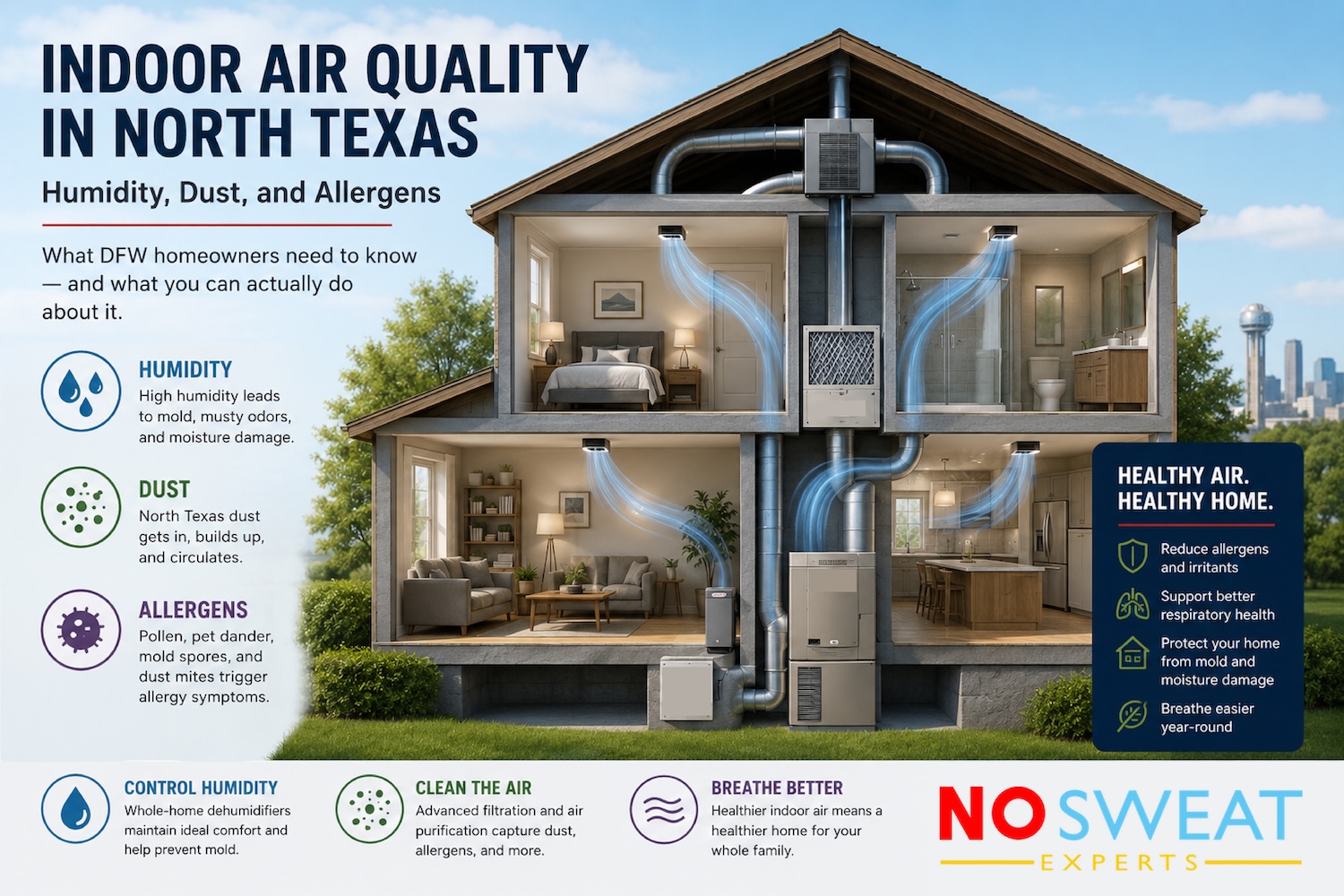
If you are concerned about what your family is breathing — and in DFW, with high pollen counts, humidity, and dust from West Texas — that is a legitimate concern worth addressing. Duct cleaning is just not an effective way to address it.
Here is what does work:
- Filter maintenance. Your air filter is your first and most important line of defense. Use the highest-efficiency filter your system’s manufacturer recommends, change it on schedule, and make sure it fits without gaps around the edges. A filter that fits poorly lets unfiltered air bypass it entirely. This single habit will do more for your indoor air quality than any duct cleaning service.
- iWave-R air purification. The iWave-R is a needle-point bi-polar ionization device that installs inside your duct system and continuously treats the air passing through it. It produces positive and negative ions that actively reduce airborne pathogens, allergens, mold, bacteria, and viruses. Unlike most air quality products, it requires no replacement parts or consumables. For homeowners who want meaningful, ongoing air treatment — not a one-time cleaning — this is one of the most effective options available.
- Electronic air cleaners. Products such as the Lennox PureAir filtration system or the AprilAire Whole-House Electronic Air Purifier are great for homeowners with allergies, asthma, or respiratory conditions. These are whole-home filtration and purification solutions that address particles, bioaerosols, and chemical vapors. The PureAir system combines a high-efficiency media filter with UV light technology to provide hospital-grade air filtration. As an authorized Lennox dealer, we can evaluate whether this is appropriate for your home and install it properly.
- Evaporator coil inspection and cleaning. As mentioned above, having your evaporator coil inspected and cleaned as needed on your annual maintenance visit is legitimate and beneficial. On every maintenance visit, No Sweat technicians check the condition of the evaporator coil and clean it if necessary. A dirty coil reduces system efficiency, restricts airflow, and will shorten the life of your equipment. This is what you should be paying for.
- Duct leak detection. Our technicians perform a high level inspection of duct connections and look for leaks on every service call. A leaky duct system does not just waste energy — it pulls unconditioned, unfiltered air from attic spaces and crawlspaces directly into your living area. The Department of Energy estimates that homes with leaky ductwork lose 20 to 30 percent of conditioned air before it ever reaches the living space. Sealing duct leaks is a real, measurable improvement to both air quality and system efficiency. If you have concerns about duct leakage, we can perform a full evaluation, with physical inspection and an infrared camera.
- Spot treatment for mold at registers. If you are seeing mold growth at supply or return registers, that is worth addressing — but it almost always indicates a moisture problem, not a duct cleaning problem. The mold at the register is a symptom. Our technicians will identify the cause: a drain pan issue, a refrigerant problem causing the coil to ice, a duct leak pulling humid attic air into the system, or inadequate airflow. Treating the symptom without finding the cause means the mold returns.
- Full duct replacement when warranted. If your ductwork is failing — collapsed flex duct, deteriorated insulation, significant moisture damage, or confirmed mold throughout the system — cleaning it is not the answer. The EPA’s own guidance notes that for flex duct in poor condition, replacement is often the appropriate solution. No Sweat offers duct replacement, and if we find ductwork in that condition during a service call, we will tell you plainly and give you an honest assessment of what it will take to fix it.
The Bottom Line
The air duct cleaning industry in DFW thrives on the gap between what homeowners fear and what the science actually supports. That gap is wide, and companies exploit it aggressively because it works.
The EPA — not a consumer advocacy blog, not a competing HVAC company, but the federal regulatory agency responsible for indoor air quality — does not recommend routine duct cleaning, has found no evidence it prevents health problems, and explicitly warns against companies making unsubstantiated health claims.
We built No Sweat Experts on the principle that honesty in this industry is not just an ethical choice — it is the only sustainable one. We are not going to sell you a service because it creates fear or because the margin is good. We are going to tell you what actually works.
If you want to talk about your home’s air quality, give us a call. We will look at what you actually have, tell you what we actually find, and recommend what will actually help.
No Sweat Experts serves the DFW and Austin metro areas. We are an authorized Lennox dealer and specialize in honest, transparent HVAC service for residential and light commercial customers. We do not offer routine duct cleaning.
Sources:
U.S. Environmental Protection Agency, “Should You Have the Air Ducts in Your Home Cleaned?” EPA 402-K-97-002. Available at epa.gov.
U.S. Department of Energy — Energy Star, “Duct Sealing.” Available at energystar.gov/saveathome/heating-cooling/duct-sealing.